
The NED and CSO: driving transformation together
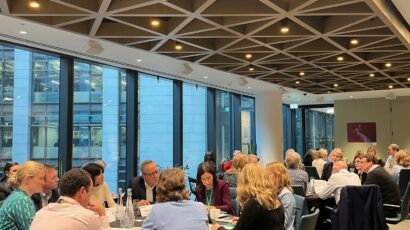
Chapter Zero’s second annual NED & CSO roundtable, in partnership with Deloitte, was testament to how fostering strong links between CSOs and NEDs can enrich strategic conversations and move ambition into action, the insights below are testament to the rich and wide-ranging nature of these discussions:
Top 10 boardroom insights
- A “business-as-usual mentality” in the boardroom is a risk: forward-thinking NEDs view commercial resilience and climate resilience as one and the same.
- NEDs and CSOs can work together to build skills and understanding in the boardroom around climate, translating the technical into the strategic – e.g. highlighting the value of reporting and disclosure for enriching conversations about investment.
- Boardroom planning cycles and scenario analysis are critical to reframing the climate conversation as risks and opportunities crystallise over 2-, 5-, and 15-year horizons.
- Broadening horizons is essential to identifying business-critical dependencies, for one beverage manufacturer this meant being aware of emerging diseases in fruit crops and modelling water scarcity across the supply chain, alongside reviewing changes in packaging regulations, recycling technologies and customer preferences, to safeguard one of its hero products.
- In a landscape of flux, the need to “manage change as we see the change” and “identify inflection points” are crucial; this requires an innovation mindset – one NED reflected that businesses can benefit from investing in dual ‘portfolios’: a “bread-and-butter” (robust) one and an “innovation” (dynamic) one to help balance risk and opportunity.
- Coupling agility with hyper-focus can help accelerate progress, for example board oversight on a business-critical issue, e.g. food waste in the food and beverage industry, can ensure cut-through, motivate the whole business and drive engagement across the value chain, with one NED remarking on the speed and success of achieving targets on this basis.
- Collaboration remains essential to tackling Scope 3: NEDs commented that across the value chain, “Many suppliers are struggling to identify their own emissions reductions, and are aware that collaboration and joint investment may be needed”; participants identified supplier–relationship management programmes and double materiality assessments as useful tools to provide strategic focus on where collaboration can be most impactful.
- Boards view AI as the “digital transition at warp speed”; one NED at a major consumer brand organisation said AI was creating a structural shift that many boards weren’t ready for. Ultimately, many felt that a tension between transparency, accountability, and commercial pressures prevails.
- Portfolio NEDs play a vital role in “bringing the outside in”; fellow board members and CSOs remarked on the value of having NEDs at the table who are seeing change at scale across the operating landscape.
- “Are we asking big enough questions?” – participants reflected that the pace of geopolitical, economic, and technological changes demands a higher level of critical thinking in the boardroom – acknowledging the power of precise and challenging questions as a driver of better decision-making and outcomes.
“Every CSO should have a NED by their side”: The importance of the NED x CSO relationship
Alongside the themes identified above, the event gave participants a vital opportunity to reflect on the importance of the NED and CSO relationship in driving progress on sustainability initiatives throughout the organisation.
One clear thread was the pivotal role that NEDs play in challenging and supporting sustainability teams to be more ambitious and long term in their thinking, a challenge that isn’t so prevalent across the C-suite, attendees warned. The portfolio nature of NEDs offers unrivalled perspective, universally summed up as the power of “bringing the outside in”. Both NEDs and CSOs reflected that the resulting challenge is to elevate the right topics to board level and avoid getting caught in the minutiae.
Clarity on ownership between CSOs and the board was deemed essential. Members of executive and board teams should understand their area of sustainability responsibility; and knowledge at executive level should be mirrored at board level. Meanwhile, ongoing education and reflection at board level are crucial, participants said. One attendee remarked that, “Part of the problem is that models used can be too general. In contrast, real examples help to capture board attention.” The consensus was that focus on ‘doing’ and using accessible language rather than jargon is effective. While, at the same time, many organisations spoke to how external stakeholders are driving the need for more granular sustainability disclosure and reporting. One NED at a listed building materials supplier shared how putting numbers to situations has been effective at moving the dial, although many agreed that data quality remains a work in progress.
“Part of the problem is that models used can be too general. In contrast, real examples help to capture board attention.”
Governance structures were highlighted as key to success, however participants reflected that alignment between sustainability committees and main boards varies by organisation. Opinions were divided as to whether sustainability should sit within a dedicated committee or be integrated into the main board. One FTSE 250 NED explained how a joint Risk & Sustainability Committee allowed the business to “dial into strategy” and surface conversations about opportunities. While a financial services NED commented that the role of its ESG & Ethics Committee is “to translate strategy into actionable plans so the CSO knows what the targets are.” Whatever the approach, there was broad consensus that it is essential for sustainability issues and key themes emerging in committees to be translated effectively to full board level. There was also agreement on the importance of regular reviews to see whether current structures add value or dilute focus.
Regular board reviews were seen as important because participants reflected that ESG priorities are not fixed; they evolve as new issues emerge. This can mean that sustainability initiatives are competing for attention with other change management projects in the organisation. To tackle this, many felt support from non-executives is vital to drive accountability, and that NEDs are uniquely positioned to effectively leverage their influence and networks as the emphasis on change can depend on who chairs or sponsors the initiative.
Participants spoke to the vital importance of NEDs and CSOs continuing to champion and articulate the business case for action. They reflected how important it was to go beyond a compliance mindset and focus on real progress, with one NED reflecting, “The journey is more important than the target.” While a financial services NED added: “ESG is not set in stone. There is no need to strive for perfection,” particularly during the ‘messy middle’ of business transition but rather to keep going. Attendees felt what matters most is that board members remain focused on their reasons for starting out on the journey in the first place and on why ongoing progress is more important than ever to ensure that their businesses remain sustainable in the broadest sense, particularly in a world where upheaval and uncertainty have become the new normal.
One thing was clear, these discussions matter. NEDs play a vital role in supporting CSOs, amplifying their voice and championing initiatives. It was encouraging to see strong appetite for regular future engagement and the creation of an ongoing NED-CSO Community of Impact to further develop these relationships – as Chapter Zero Vicky Moffatt said in her opening remarks, “Every CSO should have a NED at their side.”
Every CSO should have a board director by their side
As a part of this roundtable series we invited Chapter Zero Fellow and RemCo Chair Devyani Vaishampayan and Head of Sustainability Heidi Barnard from NHS Supply Chain, the organisation responsible for sourcing, delivering and supplying healthcare products, services and food to NHS trusts and healthcare organisations across England and Wales, to reflect on the critical role that board leadership plays in embedding sustainability throughout an organisation.
Related Content

Reset Connect 2025: Championing change and building effective partnerships
Chief Sustainability Officers (CSOs) and Non-Executive Directors (NEDs) are critical allies when it comes to shaping long-term sustainable business strategy. But success hinges on mutual understanding of priorities and effective collaboration.
Embedding sustainability into core business
Chapter Zero partnered with Deloitte in 2024 to host a roundtable discussion exploring the critical roles of non-executive directors (NEDs) and chief sustainability officers (CSOs) in driving climate and sustainability integration within business strategy. We have summarised here the key takeaways from the session.