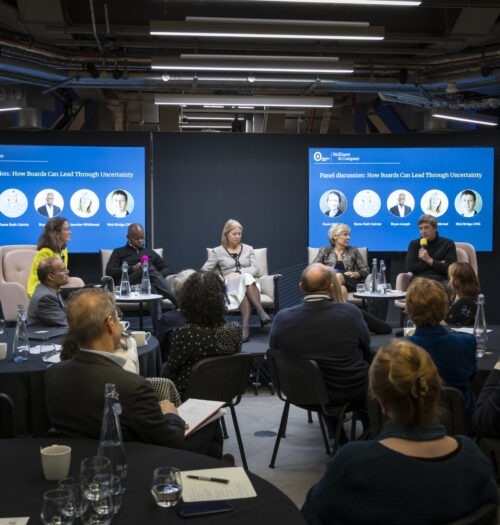
Navigating the climate/geopolitics nexus challenge
Board members have all navigated crises before. They have managed through recessions, political upheavals and technological shifts. But the world we’re governing in now feels different – and not because the challenges are new, but because they are colliding at the same time.
Climate pressures, geopolitical fragmentation, technological acceleration, supply chain fragility and social volatility – these forces are no longer isolated; they’re interconnected. They amplify each other. And they’re moving faster than our traditional planning cycles.
At the centre of all of this is climate change; not as a future risk, but as a present, defining force. Climate is a near-term disruptor of operations, assets and people; a regulatory and capital markets driver, shaping how and where businesses can invest; a geopolitical accelerator influencing migration, energy security, and industrial policy; and a business model risk that can strand assets and reshape markets abruptly.
This is why old, linear plans no longer hold, why transition risk has become financial risk, why climate strategy must be dynamic, scenario-based and deeply embedded in capital allocation and supply chain decisions, and it must be executed boldly with ambitious targets and unprecedented pace.
Boards are uniquely positioned to lead through all this complexity. But when geopolitics are added to the mix, there is a whole new level of complexity to navigate.
We saw at COP30 just how complex it is for business at the climate/geopolitics nexus. We saw what happens when key geopolitical actors are absent from the climate process. We also saw that while absenteeism sends a message, it does not necessarily derail the decarbonisation process. There is a vast array of cooperation across the world to achieve climate targets; but it is not enough given that we have now breached seven of the nine planetary boundaries.
It is not easy for boards to keep up with the pace of change and complexities of the world we now operate in. It is also not easy for companies to understand their place in solving sustainability and geopolitical problems, but in the absence of governments’ stepping up to achieve the necessary outcomes, it is for companies – led by determined boards – to act.
Now is the time to innovate
This is a time of disruption which is driving regulation, capital market activity and even whole new industrial strategies, but disruption also brings risk. That is why boards must be dynamic.
Part of the new normal is what McKinsey terms the ‘innovation-execution’ model whereby disruptors in global markets shorten the time between problem-solving and execution to deliver exceptionally fast-paced solutions that challenge the status quo. In this environment, companies who are caught napping will be the losers.
We have been here before on the geopolitical front. As we watch Chinese companies bring to market future-proofed products faster and of increasing quality, we should remember that we have seen other jurisdictions rise before and their companies disrupt. The Japanese model is a case in point. Board members should ask themselves if they are doing enough to drive change and impact.
But boards must act within the system we already have
The system in which companies operate is set. It is within this operating context we have learned to understand risk; and it is within this context companies must solve issues caused by climate change and the shifting political landscape globally.
Today, three risks dominate: liability, transition and physical risk. Liability will be a new consideration for many companies. Boards must remember that companies can be held liable for their share of climate-related harm, and litigation is a legitimate avenue for those seeking corporate accountability.
Transition is not only a risk but also a massive business opportunity. For example, battery storage costs have fallen by 90% in the last decade. We can now think about the business opportunity afforded by these advances and balance risk with reward.
Physical risk too is not only a problem requiring mitigation and adaptation, but it also affords opportunity. Carbon markets are a case in point. Innovation around the trading of carbon and the forward purchase of carbon credits along with insurance and other hedging products are bringing new prospects. Boards need to consider what all of this means for their companies too.
The need to act on climate has not changed
When it comes to climate action, we are seeing companies staying the course despite the headwinds. In fact, amongst UK-based companies (even those operating globally) there is increasing evidence of the rubber hitting the road.
But action on climate and geopolitical disruption must be treated as a key strategic issue that drives enterprise value; one that not only requires leadership from the board but also action from the executive and the right culture within the organisation in order to act.
It also means exploring what capability the company should build and working out how to monitor progress. We are moving from a phase of early commitments to delivery – this is the focus for many investors today.
This all requires doing what is right for the long-term value of the organisation, due diligence and making the investment case. This can relate to cost efficiencies (such as energy efficiency), risk mitigation, customer requirements (public procurement), ‘social value’, collaboration and, importantly, developing relationships.
What should boards do?
- It’s about long-term profitability, value and purpose of the company:
- Make the case for investment – the business case. This will probably include an analysis of return on investment, regulatory resilience and reputation management/enhancement.
- Think about the purpose of the business.
- Consider where on the risk register you should put the disruptors – and make sure the risk register is fit for purpose and is not just part of a process.
- Test the boundaries – are there areas where would you consider being an early adopter versus a fast follower? How much innovation risk are you prepared to take?
- Prioritise – move away from ‘prioritise everything’ to focus on those areas most relevant for your company; then prioritise which actions are the most critical and plan to deliver them.
- Test the culture and ensure it is fit for the purpose of change and speed:
-
- Challenge convention and make change happen. Our economies are out of balance in many ways and change is needed.
- Increase collaboration as a route through geopolitics and sustainability.
- Keep dissenting voices close and include sceptics in committees to ensure diversity of thought.
- Boards must now operate with a level of political awareness that was historically optional – be ever mindful that China is the disruptor, and change is happening anyway and it is happening fast.
Related Content
Hyper-scaling climate technologies. From ideas to shareholder value
Technologies that enable the transition to net zero were under the spotlight at an event organised by Chapter Zero and McKinsey & Company in London on 18 September 2024.

Global climate policy and COP29: implications for business
In 2024-25, Chapter Zero has partnered with McKinsey for a three-part event series that explores the impact non-executive directors (NEDs) can have on helping to accelerate their organisations’ net zero transition. The second session, held on 3rd December, analysed the international climate policy landscape following COP29 and surfaced key insights for the boardroom.
Never just tech: Unlocking sustainability success with technology
The potential applications of AI technologies across business functions are myriad and exciting, but AI has a role in the transition of companies to a low-carbon future too - that is why AI should be front of mind across boardrooms globally. This notion was at the heart of the discussion at a joint Chapter Zero and McKinsey event on 4 March 2025, as part of our ‘Out-competing to win’ event series for non-executive directors.