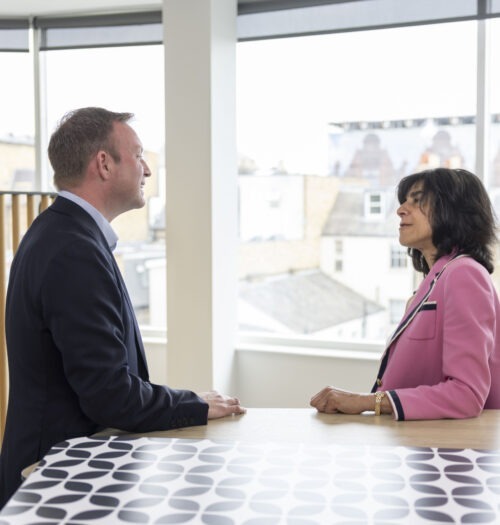
Capital can do good when invested carefully long-term
“Our scale and expertise give us the potential to play a crucial role in the reallocation of finance towards drivers of the global transition to net zero, both through our own assets and through those we manage on behalf of our clients,” says Carl Moxley (Chapter Zero member), Group Climate Director at L&G. “We do this because we believe that the transition represents an opportunity to generate long-term returns for our clients and shareholders.”
But L&G also recognises the significant investment opportunities that will arise as economies embrace new technology in the transition. The L&G board is totally on board with this thinking.
“L&G is getting involved in some really noteworthy projects,” says Nilufer Kheraj OBE (Chapter Zero Fellow), Independent Non-Executive Director at L&G. “The Board has been fully supportive of the move towards building in-house experience of nature-based solutions. This aligns with both our ambition to grow these kinds of investments as part of our transition plan commitments while seeking to ensure that these investments pay off for our shareholders and clients.”
She says that L&G believes climate change and nature loss represent financially material and systemic long-term risks and value creation opportunities for its customers, clients and shareholders. “Whilst our climate strategy is set for the long term, the board continues to oversee the incorporation of nature-related impacts and opportunities into this strategy,” she adds.
Moxley emphasises that climate change, and the twinned crisis of nature loss, require long-term commitments as well as action today. “We recognise that these efforts must be pursued alongside work to reduce environmental degradation. The two issues are materially interdependent. This aligns with our purpose: we are ‘Investing for the long term. Our futures depend on it’,” he says.
“While global action on addressing climate is facing headwinds, we have continued to make good progress on delivering against the commitments detailed in our transition plan, and remain on track against these, including the decarbonisation of our proprietary asset portfolio and emissions associated with our business.”
Transition planning and governance
“L&G’s Group Environment Committee is pivotal in overseeing our response to climate and nature-related issues,” says Kheraj. “It ensures that these issues are integrated into the company's overall strategy and decision-making processes, including its assessment of financial materiality; it also ensures that climate-related risks are integrated into the company's broader risk management framework.”
The L&G board uses scenario analysis to understand the potential impacts of different climate pathways on the company's portfolio. This involves modelling scenarios where global temperatures rise by 1.5°C, 2°C, and 4°C to assess the risks and opportunities under each scenario.
“By working closely with Carl, who oversees the Group Environment Committee and other senior executives, we are able to effectively review progress on climate goals and ensure alignment with the company's strategic and commercial objectives, promote sustainable practices and stay informed about emerging climate risks,” says Kheraj.
Moxley comments: “We believe that incorporating financially material sustainability criteria, when relevant to our clients, can create value and drive positive change. We are helping to protect customer, client, and shareholder returns while supporting a more sustainable future.”
He points out that L&G sees two significant financial risks posed by climate change: physical risk – manifesting as extreme weather events, droughts, flooding, and the other associated impacts; and transition risk – how we, as individuals, businesses and nations, come together to manage the transition to net zero.
“Our Climate Transition Plan was approved by our shareholders in 2023 and is clear that addressing climate change must be pursued in tandem with halting nature loss. We’re an early adopter of the Taskforce on Nature-related Financial Disclosures (TNFD) framework – this was a commitment to begin making TNFD-aligned disclosures in this report, and through future iterations,” he adds.
Physical and transition risk
In 2024, L&G set out its strategy for sustainable growth, sharper focus and enhanced returns. “A successful transition plays a part in all of these,” says Kheraj. “We recognise that change is typically achieved in steps, not leaps – and believe that constructive engagement with companies and policymakers is the best way to move towards net zero.”
Moxley adds: “As a business, we are starting to immerse ourselves in nature-related projects to build up first-hand experience. We are building our natural capital investment capabilities with an ambitious project aimed at developing land for a variety of nature-based solutions, including rewilding and afforestation.”
And governance is totally in step. “We are evolving our governance to ensure alignment with our business, as well as the latest science. We continue to integrate these considerations through comprehensive policies, risk mitigation techniques and oversight by Carl, and plan to refresh our Climate Transition Plan in 2026 to review our approach in this rapidly changing environment,” Kheraj says.
L&G is also building out a supplier engagement strategy to ensure it meets its supplier target by the end of 2026 and it is pleased with the strong progress it has made so far.
“But the availability of attractive assets for investing in the transition, alongside the delivery of government policy actions, is critical for ensuring we can continue to meet our targets,” says Moxley. “We have therefore continued to engage directly with the government on some of the key issues that need to be addressed to enable a green energy transition and encourage private funding of green initiatives.”
Responsible investing is key
Responsible investing is essential to creating long-term value. “We have a responsibility to many stakeholders. When we make investments, we conduct extensive research into relevant environmental and societal issues,” says Moxley.
“While we continue to do what is within our control to decarbonise our business, as a financial organisation the success of our transition is dependent on the companies we invest in delivering on their decarbonisation targets – we have been clear on this from the start.”
To date, L&G has been around for 189 years, and throughout its history it has sought to tackle some of society’s biggest challenges – from offering retirement solutions, to investing in the real economy. It has have long advocated for action on climate change and greater transparency because it recognises the financial materiality of this issue. This is why it was one of the early voluntary adopters of climate disclosures in 2019.
Its scale and expertise give it the potential to play a crucial role in the reallocation of finance towards drivers of the global transition to net zero, both through its own assets and through those it manages on behalf of clients.
Related Content
Communicating creatively about climate sparks action
There is value in communicating with creativity, especially for non-executive directors seeking to lead conversations about transition from the boardroom. Just as the science demands climate action, so too does behavioural science require that to communicate effectively, there must be creativity and humanity at the heart of messaging. This is how change happens.

From one Chair to another: the continuum of transition
SSE has a long-term decarbonisation vision. It also has a portfolio of capital-intensive projects that are focused on this goal. The company’s successive Chairs and their boards have played a vital role in the transition of the company and, as a consequence, the UK economy. Climate is a key plank of SSE’s corporate strategy.
Leadership is vital to a successful sustainable transition
International appliance care specialist Domestic & General (D&G) delivered an increase of 13.5% in adjusted EBITDA in financial year ended March 2025 over 2024. Group total revenue was up 6% year-on-year. As part of its commitment to sustainability, D&G’s repair-first ethos – what it calls ‘Smart Fix’ – remains at the heart of this success.