
What the IPCC report means for non-executive directors
The UN Intergovernmental Panel on Climate Change (IPCC) has completed its Sixth Assessment Report (AR6). With the IPCC's next report expected around 2030, this is likely to be its last assessment report published in this critical decade for climate action.
As part of AR6, four important reports containing the latest scientific knowledge on climate change have been released since August 2021, with the last in March 2023.
Here are the key takeaways are for NEDs:
- Limiting global warming to 1.5°C above pre-industrial levels is still achievable but requires immediate, rapid, and large-scale reductions in greenhouse gas emissions.
- Board directors play an important role in ensuring the organisations they represent set, and deliver upon, ambitious climate targets and transition plans.
- The report provides unequivocal evidence of the link between human activity and global warming. It highlights the devastating risks and impacts for people and nature, including material risks for business.
- Board directors should consider these risks and impacts for the businesses (and broader value chains) they oversee, disclose the findings, and put in place appropriate measures to address them.
- The cost of inaction is likely to be much higher than the cost of action to limit warming to 1.5°C in the medium to long-term.
- Bold climate leadership today, both to reduce emissions and adapt to the impacts of climate change, will serve long-term business interest.
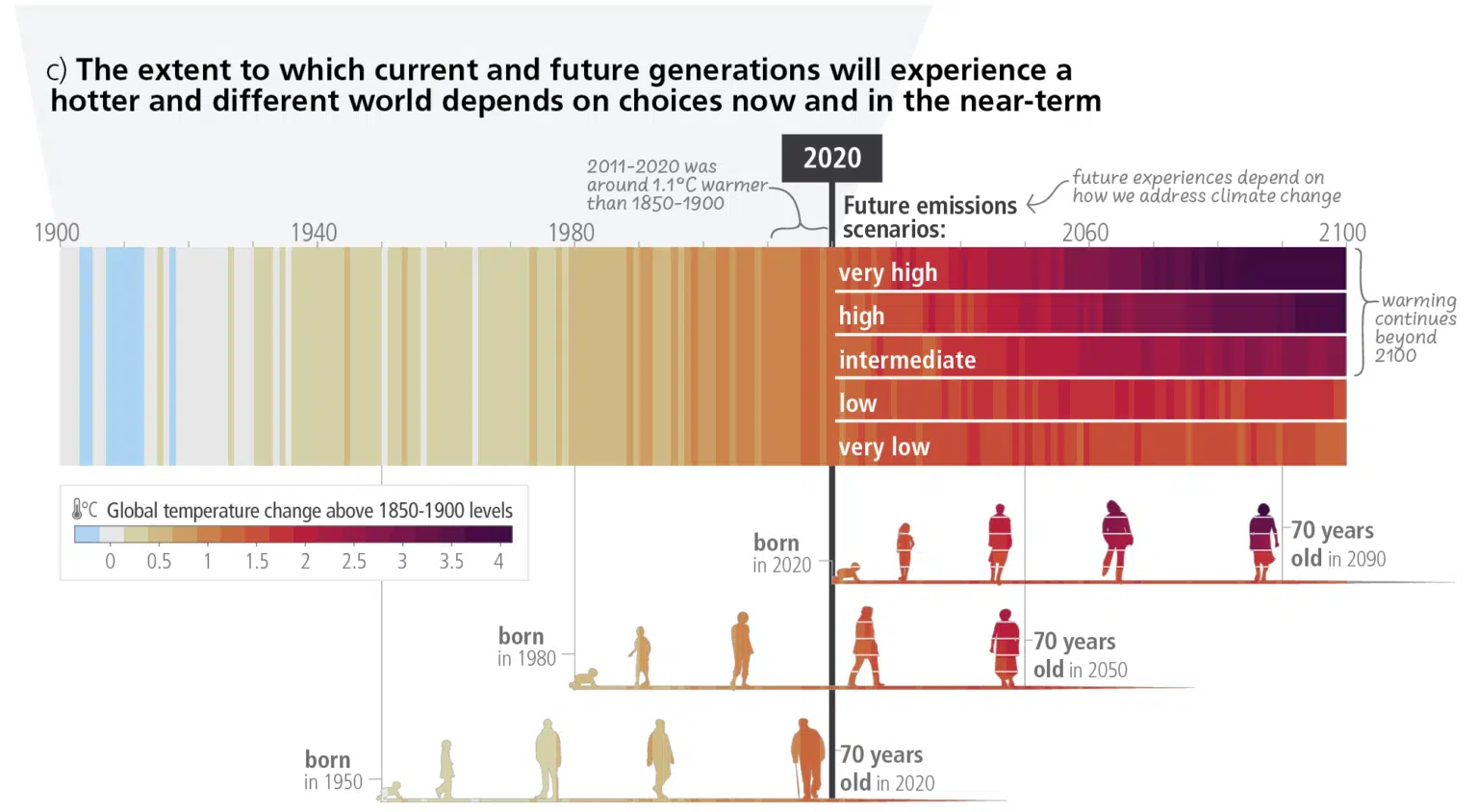
How choices made in the near term could affect future generations. Source: IPCC, 2023. Synthesis Report of the Sixth Assessment Report, Figure SPM.1, p.7Shape
April 2022: Mitigation of Climate Change
This report focused on mitigating climate change by reducing greenhouse gas emissions – the central part of any organisation’s climate policy.
Read the summary for NEDsFebruary 2022: Impacts, Adaptation and Vulnerability
This report concluded that the impacts of climate change are severe, but that humanity can still avoid many of them if it seizes “a brief and rapidly closing window of opportunity”.
Read the summary for NEDsAugust 2021: The Physical Science Basis
This report showed that human activity is unequivocally driving changes to the climate at an unprecedented scale. The science indicates there is still time to limit temperature rises, but only if we act now, and with ambition.
Read the summary for NEDsRelated Content

Watch: Sustainability Regulation Outlook 2026: shaping growth, value and resilience
Watch this webinar hosted by Chapter Zero and the Deloitte Academy in February 2026, where expert speakers explored evolving regulation, resilience, and competitiveness against the backdrop of Europe pressing ahead with its sustainability transition amid economic and geopolitical uncertainty.

Vulcan Energy: innovation generates transformation
Taking a pioneering approach to technology, financing, policy, energy security, stakeholder engagement and markets, Vulcan Energy is pursuing an innovative geothermal and lithium production project in Germany’s Upper Rhine Valley. Chapter Zero member Josephine Bush chairs its Audit, Risk and ESG Committee. Here, she explains how stakeholder collaboration, and a board that combines the necessary skills and experience, aims to deliver one of Europe’s most transformational projects – Phase One Lionheart.

EU Carbon Border Adjustment Mechanism (EU CBAM)
The EU's Carbon Border Adjustment Mechanism (effective from 1 January 2026) requires EU importers to report on and purchase CBAM certificates to cover the emissions embedded in their imported goods. This UK Government briefing helps NEDs keep up to date with the latest regulatory requirements for EU imports, including: iron and steel, aluminium, cement, fertilisers, hydrogen, and traded electricity.