
Sustainable Procurement: a strategy for resilience and growth

“Sustainable procurement is not just a CSR initiative — it’s a business strategy that increases resilience, reduces long-term costs, builds stronger brands, enhances investor confidence, and drives innovation. Companies that adopt it become more competitive, adaptive, and future-proof.”
- Devyani Vaishampayan, Chapter Zero Fellow, Independent Director at Forvis Mazars, RemCo Chair and Non-Executive Director at Supply Chain Coordination Limited, RemCo Chair and Non-Executive Director at Norman Broadbent Plc
Board Summary: a 5-minute read
In practice, procurement is a touchpoint across the full spectrum of NED oversight responsibilities – procurement choices shape risk exposure, market access and competitiveness, brand identity and reputation, and assurance.
Regulatory reform is also creating key market signals for boards. The Procurement Act 2023, which came into effect in February 2025, and the corresponding National Procurement Policy Statement (NPPS) have introduced significant reforms that aim to improve transparency, efficiency, and effectiveness in public procurement – with the latter outlining increased focus on “taking account of environmental risks and ensuring suppliers are committed to high environmental standards and protecting natural habitats and biodiversity.”
According to the Competition and Markets Authority (CMA), public procurement represents a £385 billion opportunity to “tackle the UK’s scale up challenge”, enabling businesses to secure revenue-generating contracts and unlock financing.
Prioritising low-carbon public procurement in the boardroom can support non-executive directors in leveraging both the public sector’s and businesses’ own purchasing power, helping to create long-term value.
Key takeaways for boards
- Shifting towards a low-carbon procurement model as a strategic board priority is as much about market competitiveness as compliance: Low-carbon procurement is a strategic business approach that strengthens competitiveness in a market where demand for climate-friendly products and solutions is accelerating. Embedding greener procurement as a visible component of brand identity may also increase investor interest and better attract purpose-driven partners.
- Sustainable procurement can drive innovation and differentiation: Working with sustainable suppliers can encourage the adoption of new technologies, materials, and processes (e.g., low-carbon goods, circular solutions). Doing so, can be a valuable differentiator in a crowded market.
- Boards face growing investor and government scrutiny over how procurement choices reflect climate responsibility: Uptake of mandatory green public procurement requirements is being felt beyond the UK, and the direction of travel suggests that more governments will continue to integrate sustainability criteria into procurement rules in line with sustainable investment trends.
- Greener procurement is a critical lever for managing systemic risk: A study by McKinsey finds that approximately two-thirds of the average company’s sustainable footprint can be attributed to its suppliers. By embedding environmental and social considerations into sourcing decisions, businesses can reduce exposure to supply chain disruptions, regulatory changes, legal risks, and climate-related shocks.
- Concerns about the upfront costs of greener procurement options are offset by the long-term savings and resilience benefits they generate: Adopting a long-term view of procurement’s impact across the entire business lifecycle is essential to ensuring businesses fully capture the value presented by the growing green public procurement market.
- Partnerships can power market demand: Public-private partnerships can support early market engagement in public procurement, leveraging the public sector’s significant purchasing power to help businesses manage the upfront costs involved in developing climate-friendly products and solutions and drive up demand.
- Businesses’ procurement data and insights are underutilised tools for driving strategic influence and public sector collaboration: Strong data governance and transparency in procurement not only enhances internal performance but also positions businesses as credible, strategic partners to government and contracting authorities.
Board discussion prompts
Deep Dive: a 10 minute read
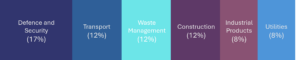
Emissions data from the United Nations Framework Convention on Climate Change (UNFCCC) shows that public procurement is responsible for approximately 7.5 billion tonnes of CO₂ annually, equivalent to nearly 15% of global greenhouse gas (GHG) emissions. World Economic Forum analysis finds that 70% of public procurement emissions originate from six key sectors:
In terms of how businesses across sectors can address emissions impact, a 2023 study by the International Institute for Sustainable Development (IISD) outlines a layered approach to climate-aligned procurement:
- Sustainable public procurement (SPP) is a process by which public authorities seek to minimise environmental costs and maximise social and economic value in public procurement, providing value for money across the lifecycle of the goods, services, and infrastructure they buy.
- Green public procurement (GPP) focuses on the environmental component of sustainable procurement, promoting environmental goals through public spending. Commonly associated mechanisms include green/eco labels and certifications for products and services, lifecycle costing, environmental-based supplier screening criteria, and performance-based contracts.
- Low carbon procurement (LCP) has a particular focus on reducing or avoiding carbon emissions through procurement, which any entity – public or private – can utilise to reduce the carbon footprint in purchasing decisions. LCP strategies are utilised in broader GPP efforts, e.g. in carbon reduction criteria in public tenders.
Mandatory low carbon public procurement criteria are increasingly common as countries align purchasing practices with climate goals, with all 34 OECD members integrating environmental objectives and over two-thirds setting quantitative green public procurement targets. In the EU, green public procurement is “gaining regulatory teeth”, becoming mandatory across many contracts and supported by the European Structural and Investment Funds (ESIF) – the largest investment toolbox under the EU budget. Awareness of the global policy context around green public procurement is vital to UK NEDs, considering that without it, UK businesses risk non-compliance with existing international contracts, supply chain fragmentation, exclusion from future international contracts, and loss of competitiveness to peers who are better positioning themselves to meet emerging mandatory low-carbon standards.
Navigating the challenges to green procurement: how boards can establish sustainable procurement strategies that save costs, reduce waste, and deliver better outcomes
Despite progress, businesses tend to experience 5 key challenges to integrating a low-carbon procurement approach: lack of clarity, availability and cost, capacity gaps, supply chain management, and monitoring and evaluation. This fictional example exemplifies the role the board and non-executive directors can play in addressing these challenges.
As a buyer, businesses should prioritise a sustainable, resilient supply chain. Procurement should drive decarbonisation across the product/services lifecycle – minimising waste generation, maximising material recovery, and actively applying circular economy principles.
As a seller, businesses should provide products and services that minimise emissions from their own operations. Leveraging sustainable impact allows organisations to compete effectively whilst demonstrating corporate responsibility.
Further reading/ resources
- The World Economic launched the Green Procurement Playbook in October 2025, offering guidance for Chief Procurement Officers on how to elevate green procurement to the strategic agenda.
- The Institute for Government (IfG)’s report, The role of procurement in delivering mission-led government, provides more detailed analysis of the barriers to effectively using public procurement to support the government’s missions, as well as key policy recommendations.
- Supply2Gov offers a Procurement Act 2025 compliance checklist for SMEs, which provides an overview of the policy’s key changes and opportunities.
- CertBetter offers a practical guide to ISO 20400: Sustainable Procurement, outlining practical steps for determining the standard’s use case and how to implement it.
- This case study of waste management company, Biffa, highlights how giving procurement a seat on the board can drive strategic value: Benefits of Procurement sitting on the board - Case Study | Efficio US
- Launched in 2024, the Sustainable Procurement Pledge has co-developed a set of principles for integrating carbon pricing into tender evaluation and supplier selection processes.
- A thought experiment from board director, Izzy Fenwick, offers helpful framing around the procurement-governance risk nexus, particularly as it relates to businesses’ nature risk profile.
- The Science Based Targets Initiative (SBTi)’s guide, Engaging supply chains on the decarbonization journey, sets out actionable supplier engagement steps businesses can take to address scope 3 emissions reduction. The We Mean Business Coalition has similar guidance: Building Resilient Supply Chains: Getting the Most out of Supplier Engagement.
- The Institute for Sustainable Development (IISD)’s report, The CO2 Performance Ladder as a Tool for Low carbon procurement, delves deeper into the feasibility of using the CO2 Performance Ladder green public procurement tool across ten countries, including the UK.
- A 2024 study, Does green procurement pay off? Assessing the practice-performance link employing meta-analysis, further outlines the business case for green procurement practices.
- A 2023 report, How strategic public procurement creates social value: Evidence from UK anchor institutions, outlines academic research into the social value aspect of public procurement.

Dr Jellie Molino
is an international legal expert on sustainable public procurement (SPP) and Post-Doctoral Research Associate at the Centre for Climate Engagement, advising global organisations on climate-procurement governance. She is also International SPP Expert for the World Bank in Bangladesh, Türkiye, and Angola.Related Content

2025 Sustainability Regulation Outlook
The regulatory landscape around sustainability continues to evolve, creating significant complexity across industries. During the last legislative mandate in the EU, there was a wave of new sustainability regulation entering into force. Now, after the 2024 EU elections, there will be a call for action for a renewed sustainability strategy (“Green Deal 2.0”), fostering sustainable competitiveness and strategic autonomy, and driving green innovation. Join Chapter Zero and the Deloitte Academy for this webinar, where we will explore Deloitte Academy’s third annual flagship report, focusing on the topics that are considered most critical through the lens of their potential to affect business strategies, operating or financial models for 2025.

Wates: an adaptive mindset generates value
Jonny Wates is a Board Director of the Wates Group – a nearly 130-year-old, multi-generational, family-owned construction, property services and developments company based in the UK. He chairs the board’s Sustainability Committee and champions sustainability at both a strategic and operational level. In a case study on how the company’s stewardship ethos drives decarbonisation and the futureproofing of the business, Jonny talks about how, with an adaptive mindset, boards can steer businesses to both address global challenges and generate value.

Beyond compliance (part 1): NEDs and the evolving regulatory landscape
Sustainability regulations are evolving at an unprecedented pace. New disclosure standards, transition planning requirements, and the scrutiny on green commitments are redefining expectations for firms globally. Part 1 of this two-part insights piece, from Chapter Zero Fellow David Carlin, explores how boards can get ahead of the changes and harness reporting to drive business value.