
The Chapter Zero Board Scorecard: an introduction
Why use the Board Scorecard?
Complete the Board Scorecard to help you assess how effectively your board is tackling the net zero transition and building resilience to climate impacts.
- It will indicate how well you think your board is responding to the challenge of climate change
- It will help you make informed decisions on priorities for action, and ask the right questions in the boardroom
- You can use the Board Scorecard results to capture impressions from board members and others in the organisation, to enable a good discussion
- It can help identify gaps to be addressed, differences of view and barriers to be overcome.
- If you want to dig further into transition planning, look at the Chapter Zero Transition Planning Toolkit, and complete the Transition Planning Scorecard which is designed for companies who are moving forward with their Transition Planning journey.
How it works
To complete the Board Scorecard you need to answer a total of 20 questions. These are split across four different topic areas: leadership, ownership, strategy and measurement. The questions are designed to help you assess how effectively your board is tackling the net zero transition and building resilience to climate impacts.
Upon completion you will be emailed a PDF of your results that you can take to the boardroom to facilitate discussion. The information you give, including your email address and scoring, will be stored securely. We will not identify your company if we use the results for data analysis purposes.
Here is an example of the PDF output:
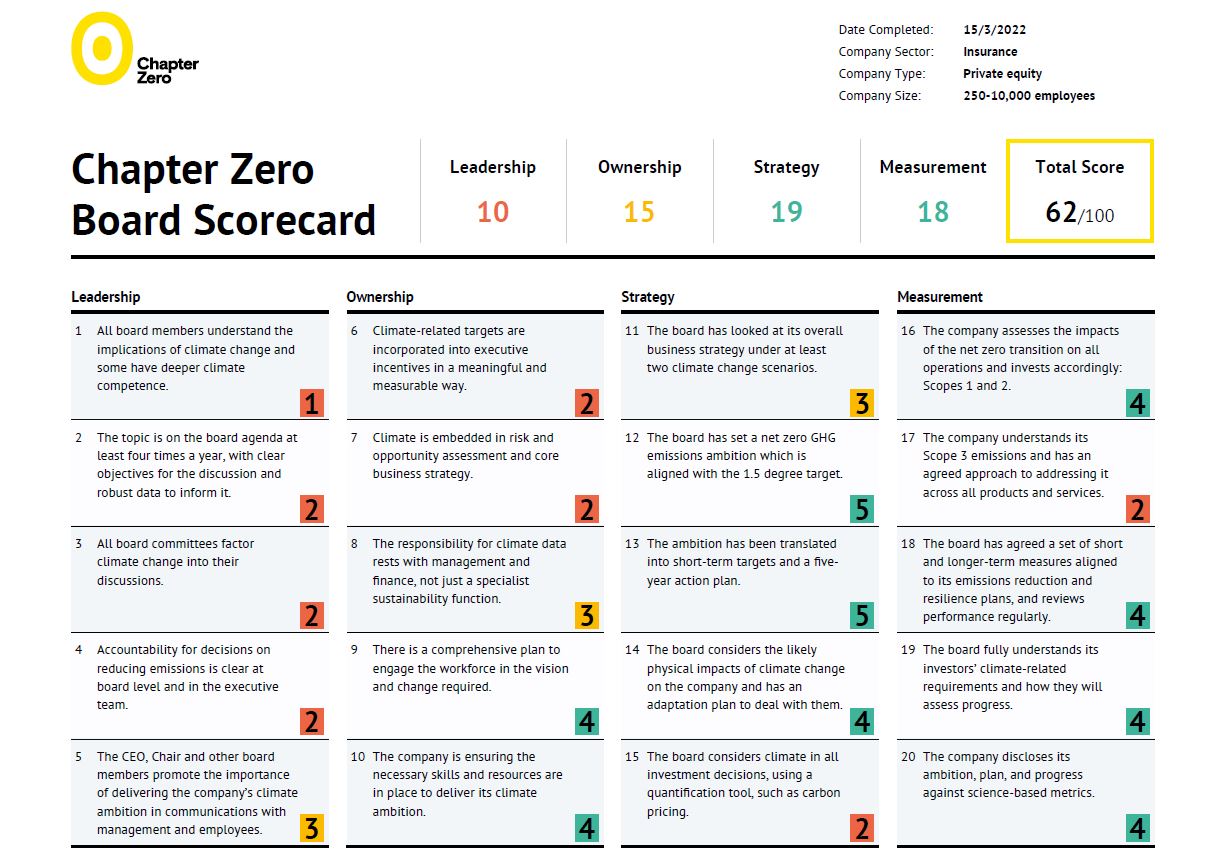
The Board Scorecard is not intended to be rigorous. It is designed to capture and encourage debate in the boardroom.
Give it a try
Board ScorecardRelated Content

Climate inaction could lead to 34% drop in profits by 2030
On the 10 February 2026 Apparel Impact Institute published new research, The Cost of Inaction, a landmark analysis illustrates how climate risks are increasing costs for companies in the fashion industry.

Global Fast Fashion: A Climate and Nature-related Risks Scenario Game
Climate change and nature loss are altering business landscapes across supply chains, infrastructure, consumer behaviour, and regulation. They require the attention of boards not because of external pressure alone, but because they shape long-term resilience, competitiveness and corporate value.
Asking Better Questions on Nature – For board directors
This “Asking Better Questions on Nature” guide is designed to help non-executives and boards across business and finance surface critical insights about nature-related dependencies, impacts, risks and opportunities to inform their decision making.